
Which Hail Storms Are Actually Worth Chasing? (Hint: It's Not Always the Biggest)
Bigger hail grabs attention, but it doesn't always mean more roofs. Here's how to use Hatch Lines and Star Ratings to spot the storms actually worth deploying crews to, before you commit time and budget

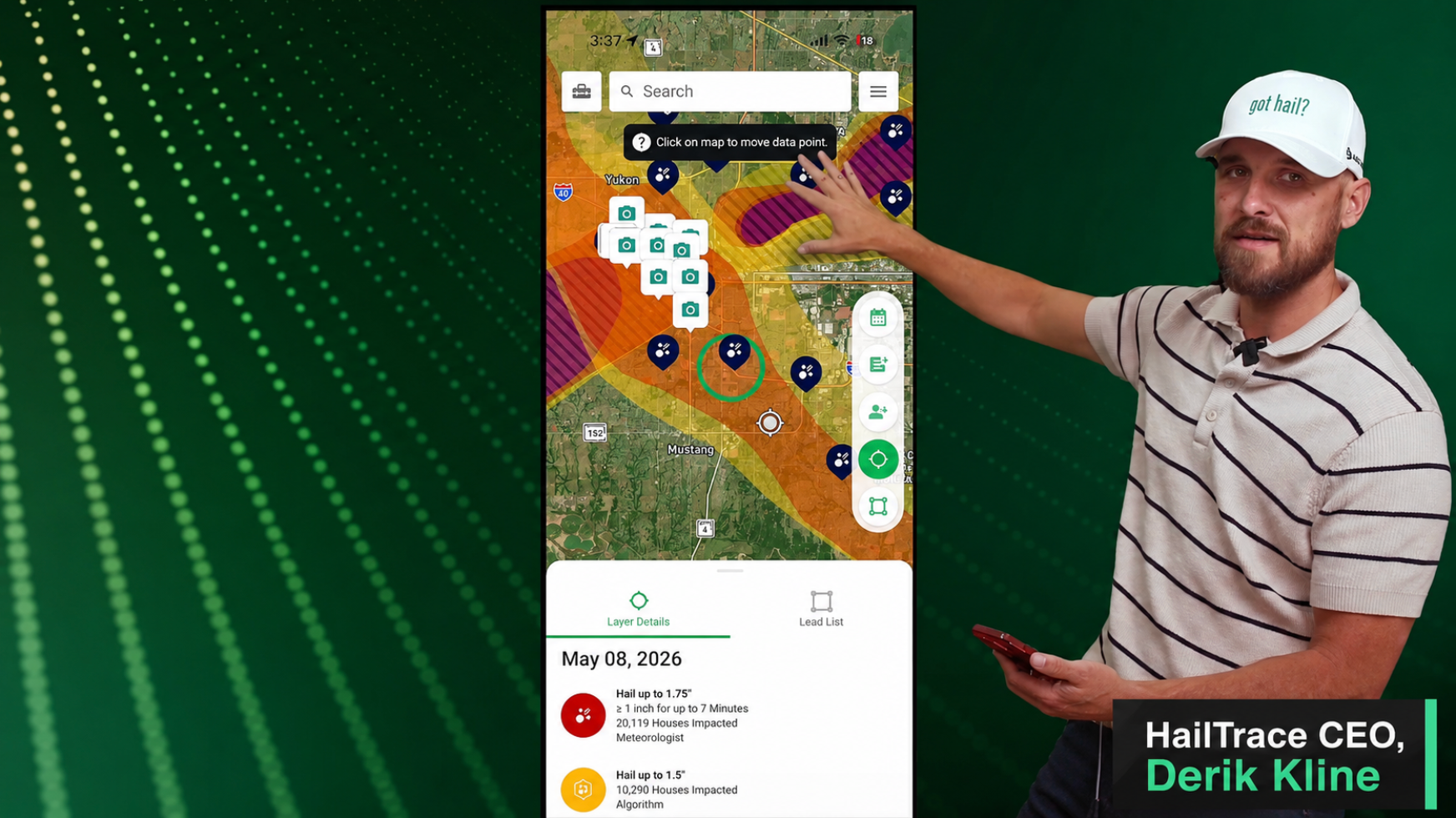
Every spring, contractors make the same costly mistake.
A new hail alert comes through. The hail size looks impressive. Crews are redirected. Marketing dollars get shifted. Time and energy are invested chasing the newest storm on the map.
But bigger hail doesn’t always mean better opportunities.
In many cases, a storm with smaller hail and higher volume will produce significantly more roof replacements than a storm with larger hail that only occurred in isolated pockets.
That’s why HailTrace introduced Hatch Lines: a map overlay that identifies isolated hail with low hail volume. Combined with Star Ratings, Hatch Lines help contractors quickly determine which storms deserve their attention and which ones may not be worth the investment.
How to read hail distribution on the map
Derik explains the significance of isolated hatching lines on a hail map and how they should influence a professional's approach to assessing storm damage. Courtesy, HailTrace.
Hatch Lines show where hail was present, but in very low concentration. This typically means that while hail was detected in the storm system, only a small number of stones actually fell over a wide area; sometimes just one or two stones per yard.
This matters because “hail present” doesn’t automatically mean “roof damage present.” With isolated hail, the likelihood of any specific roof being impacted is low, even if the storm looks severe on radar or mapping tools.
Solid Colors vs. Hatch Lines: Reading the Map Correctly
Solid colors typically represent areas where hail fell with more consistent coverage and higher frequency across the ground. In other words, it’s not just that hail occurred, it’s that it likely impacted a much larger percentage of roofs in that zone.
This is where hail volume becomes critical.
A storm with golf-ball sized hail spread consistently over an area can often cause more widespread roof damage than a storm with baseball-sized hail that only hits in isolated pockets.
Even though the hail is smaller, the repeated impacts across many properties increase the likelihood of real, detectable damage. In contrast, isolated large hail may look more severe on paper, but if it only hits in scattered spots, many roofs may never actually get struck.
What Star Ratings Actually Tell You
Derik explains how HailTrace uses a star rating system to assess the severity of hail storms and the likelihood of property damage. Courtesy, HailTrace.
Star Ratings aren’t just about hail size. They help contractors understand the overall quality and confidence level of a storm event.
A 3-star storm may indicate moderate confidence in hail coverage, while a 5-star storm typically signals a high-confidence, high-impact event with stronger validation behind it.
A 3-star storm with larger hail may actually produce fewer actionable opportunities than a 5-star storm with smaller hail, especially if that larger hail occurred in isolated areas.
Derik explains why the volume of hail can be more significant than the size of the hail stones when determining storm damage and map ratings. Courtesy, HailTrace.
When Star Ratings and Hatch Lines are used together, contractors gain a much clearer picture of storm potential before committing valuable resources.
Deciding which storms to work
Derik discusses sales strategies for roofing contractors using weather data to identify hail damage and maximize revenue. Courtesy, HailTrace.
These map tools aren’t just about seeing where hail fell, they’re about deciding which storms are actually worth your time and resources.
The real skill is knowing when to stay committed to an older, well-documented storm versus chasing a newer but less reliable one. A proven storm with strong historical validation often continues to produce better results than jumping early into flashy but low-confidence data.
Reinvest what the reliable storms pay you
Successful storm work also feeds back into strategy. Revenue generated from reliable, high-profitability storms can be reinvested into marketing or canvassing efforts around larger weather events.
This creates a cycle where proven data helps fund expansion into bigger opportunities.
Essential Tools for Efficiency
The Locator Tool
Zoom into specific properties and instantly pull hail history, storm tracks, and property counts. It tells you fast whether an area is worth deploying.
The bigger advantage: surfaces storm overlap zones and areas that have been hit multiple times. When hail stacks over the same geography, the odds of real, actionable damage climb, which makes those areas your highest-priority inspections
Mobile Notifications
Real-time alerts the moment hail is detected in your service area. That's your edge on early response and lead capture before competitors move.
Favorite Maps
Save and compare historical storms against current events to spot patterns and validate trends, instead of working off one isolated storm at a time.

This spring, an Oklahoma City contractor could have chased a 3-star baseball hail storm and burned two weeks knocking on empty ground. Or waited for the 5-star golf ball storm and worked their best month of the year. The bigger storm lost. Here's why, and the map-reading framework that works in every market.