
Are All Hail Maps the Same? What Every Roofer Needs to Know
If two hail maps are different, at least one of them is wrong. The challenge is knowing which one to trust.

What You'll Learn
- Why hail maps aren't all the same
- How hail map accuracy impacts roofing sales
- The difference between algorithm and meteorologist created hail maps
- Three real storms that show why accuracy matters
- Why HailTrace approaches storm mapping differently
Not all hail maps are created equal.
Every roofing company has experienced it.
You spend days working what looked like a great storm—knocking doors, running mailers, and sending sales reps into a neighborhood that seemed full of opportunity.
Then the results don't come.
Meanwhile, another contractor finds hail damage just a few miles away. The difference isn't always the sales team. Sometimes it's the hail map they trusted.
Every decision after a storm starts with the map.
The neighborhoods you canvass. The marketing campaigns you launch. The sales reps you deploy. The opportunities you pursue.
If the map is wrong, every decision that follows becomes more difficult.
So why do hail maps from different companies often look so different?
Why Hail Maps Aren't All the Same
If you've ever compared hail maps from two different providers, you've probably noticed they don't always agree.
One map may show a neighborhood receiving significant hail, while another barely shows the storm.
And if two hail maps are different, at least one of them is wrong.
So which map is right?
The answer usually comes down to how the map was created. Every hail map starts with radar. The difference is how that data is interpreted.
Some weather providers rely primarily on automated algorithms or AI to estimate hail size and storm paths.
Others use trained meteorologists to create hail maps using radar data and real-world storm evidence.
That difference may seem small.
But it can influence every business decision that follows.
The Hidden Cost of "Close Enough" Hail Maps

A hail map isn't just weather data. It's a business tool.
Roofing companies use hail maps to decide:
- Which neighborhoods to canvass
- Which storms are worth working
- Where to run mailers and digital ads
- Where to send sales reps
When a hail map is inaccurate, the cost becomes real.
An inaccurate map can mean:
- Hours of time driving neighborhoods with little or no damage.
- Thousands of dollars spent on mailers and digital ads targeting homeowners who were never impacted.
- Sales reps knocking the wrong doors while competitors work neighborhoods with real opportunity.
- Missing entire sections of a storm that never appeared on your map.
The biggest cost isn't always working the wrong neighborhood. Sometimes it's never knowing the right neighborhood existed.
Finding a storm is only the first decision.
Choosing the right neighborhoods inside that storm is where profitability is won or lost.
Algorithm Hail Maps vs. Meteorologist Hail Maps
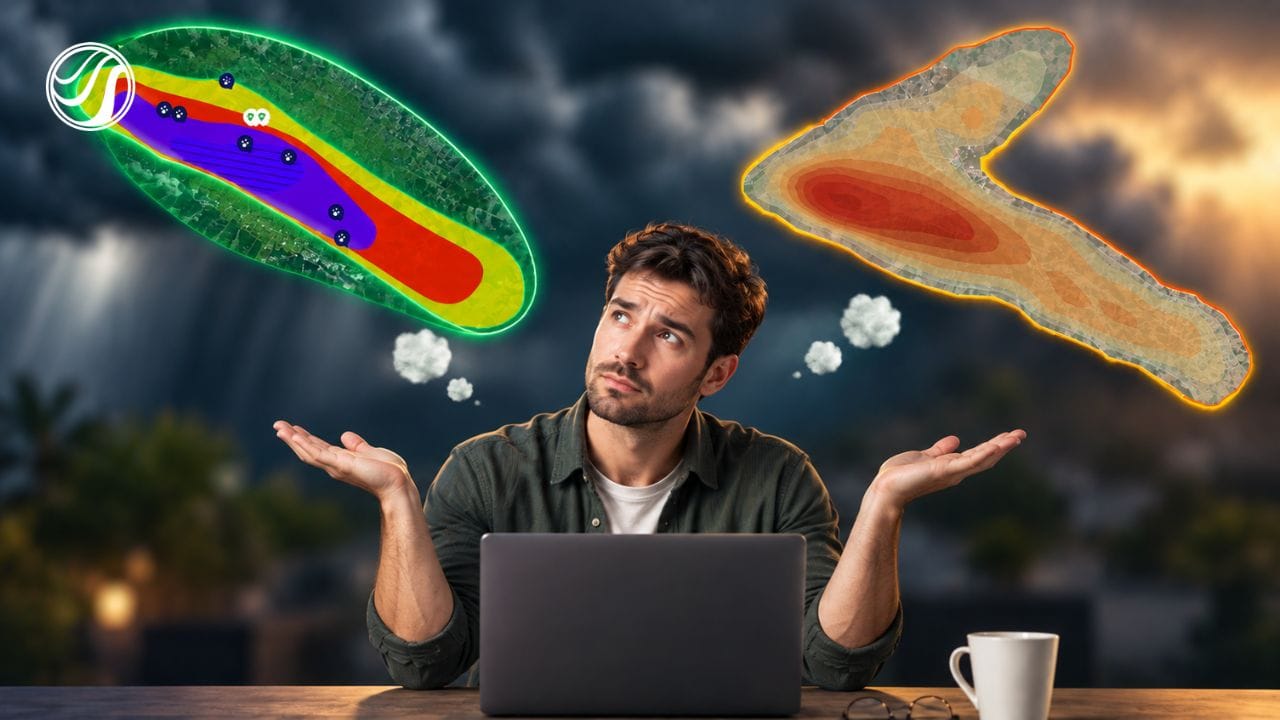
Companies use one of two things to interpret radar data and create hail Maps: algorithms and meteorologists.
Algorithm-Generated Hail Maps
Many hail map providers use automated algorithms or AI to estimate where hail occurred.
These models rely on radar data collected thousands of feet above the ground to estimate hail size and storm paths.
It's a fast and consistent process.
But storms don't always behave the way computer models predict.
Factors like wind can shift hail away from where the radar first detected it, causing the final storm path to differ from what actually happened on the ground.
As a result, algorithm-generated hail maps may not always provide the most reliable picture of where hail actually fell.
Meteorologist Created Hail Maps
Storms are complex.
Instead of using algorithms to generate storm paths, meteorologists use their expertise, radar data, and real-world evidence to create maps that better reflect what actually happened on the ground.
Here's how HailTrace meteorologists create hail maps:
- Identify Severe Storms: Monitor and identify significant hail, wind, and tornado events across the country.
- Map the Storm: Analyze radar data alongside ground truth reports and real-world observations to map the storm's path.
- Verify Accuracy: Review and refine the completed map for accuracy and quality before publishing.
A simple way to think about the difference is:
Algorithms trust the radar. Meteorologists trust but verify.
Why This Matters
Storms don't always behave the way computer models expect.
- Wind can shift hail as it falls.
- Storms can split apart or change direction.
- Some neighborhoods receive damaging hail while nearby areas receive very little.
Radar provides an excellent starting point. But it doesn't always tell the complete story.
That's where a meteorologist can make the difference.
Two Ways Algorithm Hail Maps Can Lead You Astray
When a hail map isn't accurate, it usually creates one of two problems.
False Positives: Working Areas That Never Got Hit
Sometimes a hail map shows meaningful hail where little or no roofing damage actually occurred.
That can lead to:
- Sales reps wasting valuable time
- Marketing dollars spent in the wrong neighborhoods
- Teams losing confidence in their storm data
Every day spent in the wrong neighborhood is time your competitors may be spending somewhere better.
False Negatives: Missing Areas That Were Hit
The opposite problem is often even more costly.
Sometimes a hail map completely misses neighborhoods that experienced significant hail.
That can lead to:
- High-opportunity neighborhoods going untouched
- Competitors finding those jobs first
- Revenue being lost before you even knew the opportunity existed
If your map doesn't show the storm, your team never has the chance to work it.
Three Real Storms That Show Why Accuracy Matters
Now let's look at three real storms where map accuracy could have changed where contractors spent their time, money, and effort.
Property counts below compare an algorithm generated map against HailTrace's meteorologist map for the same storm.
May 26, 2025 — San Antonio, Texas
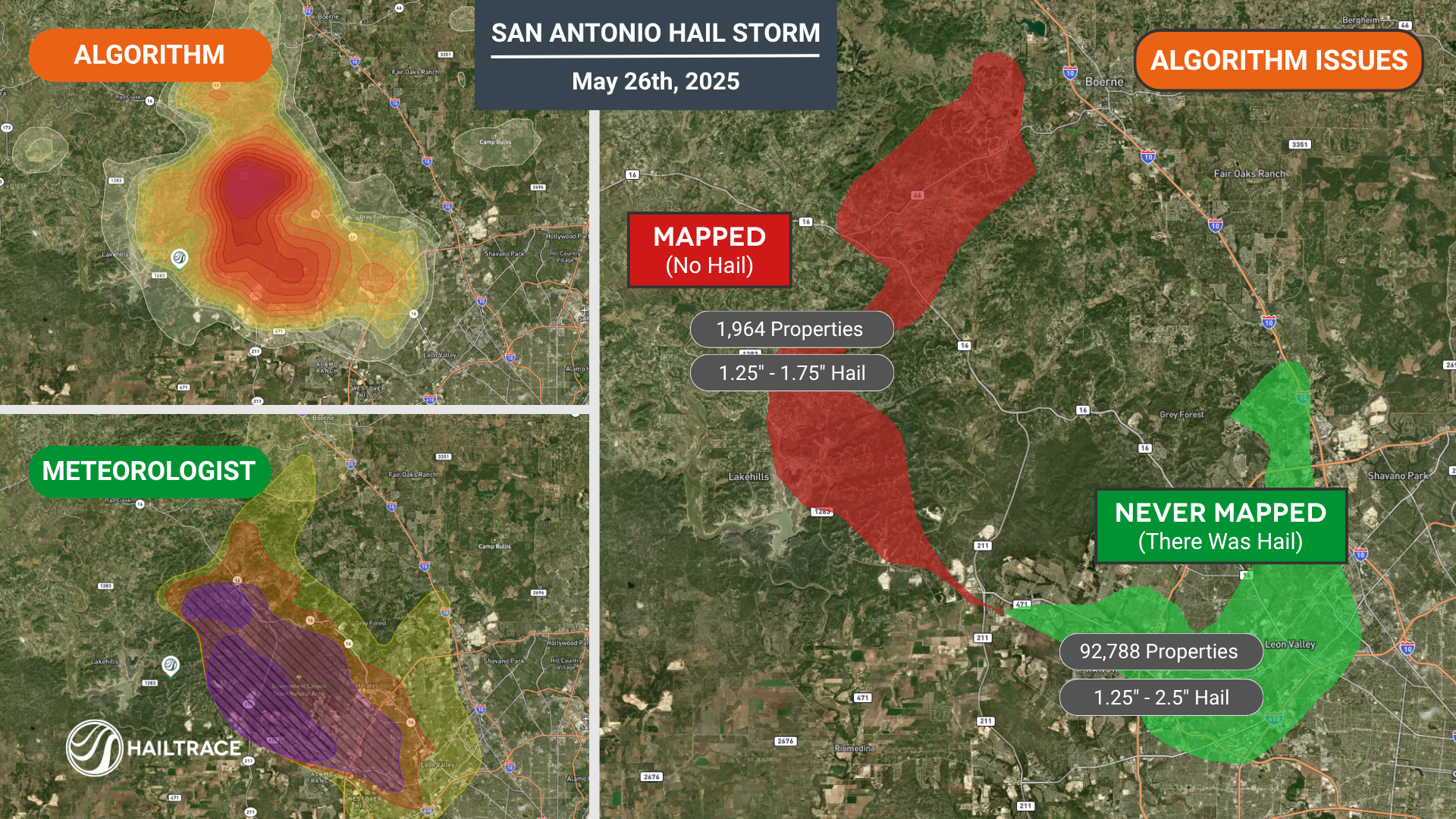
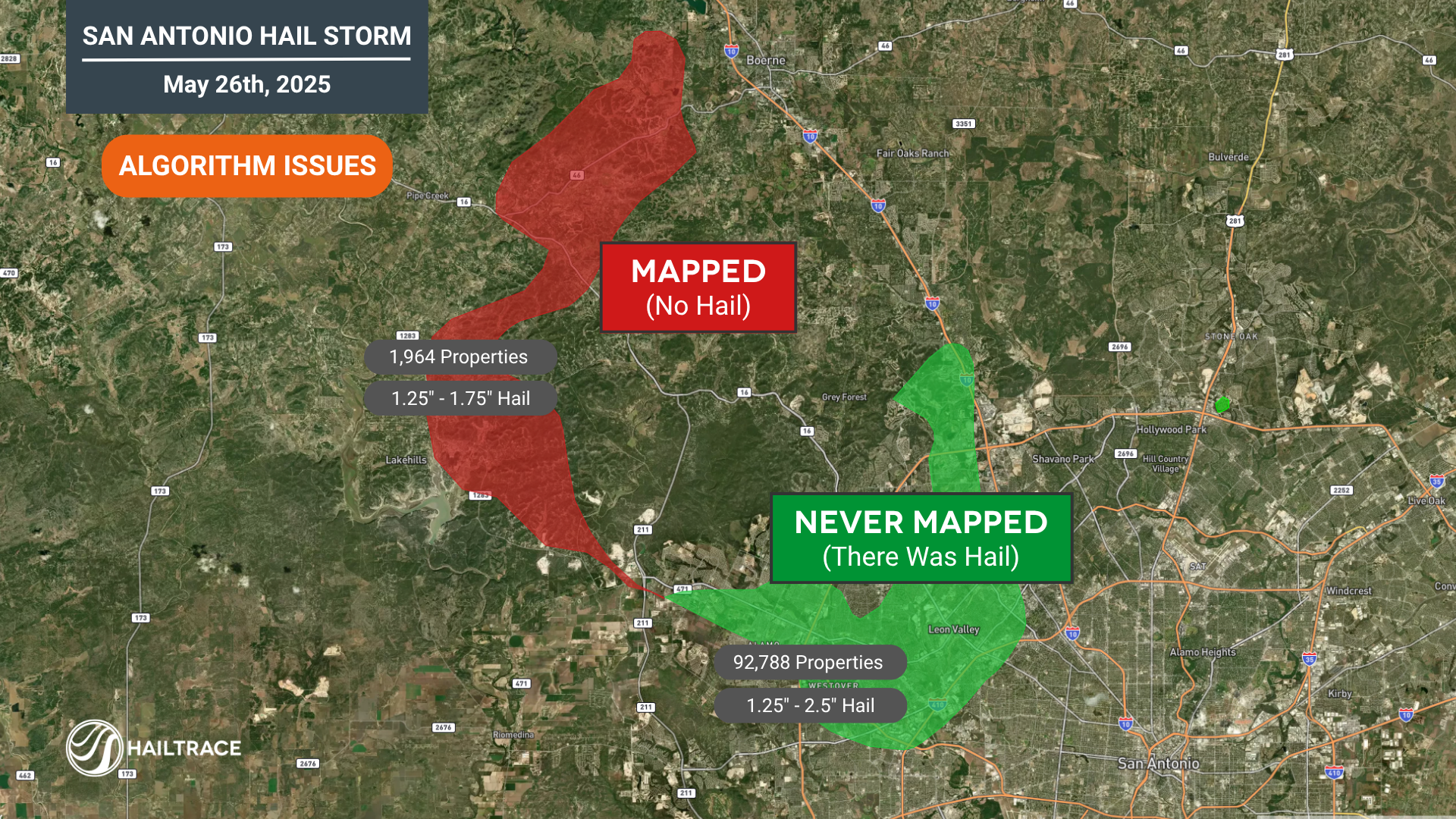
The May 26th, 2025 storm that hit San Antonio, Texas demonstrates both major types of mapping errors: false opportunities and missed opportunities.
Algorithm Map Results
- ❌ 1,964 properties incorrectly mapped as receiving 1.25"–1.75" hail
- ❌ No meaningful storm impact occurred in this area
- ❌ 92,788 properties receiving approximately 1.25" - 2.5" hail were completely missed
Business Impact
- Marketing dollars spent where little or no damage existed
- Sales reps knocking neighborhoods without opportunity
- Tens of thousands of properties in the hail path never appeared on the map
March 10, 2026 — Chicago, Illinois
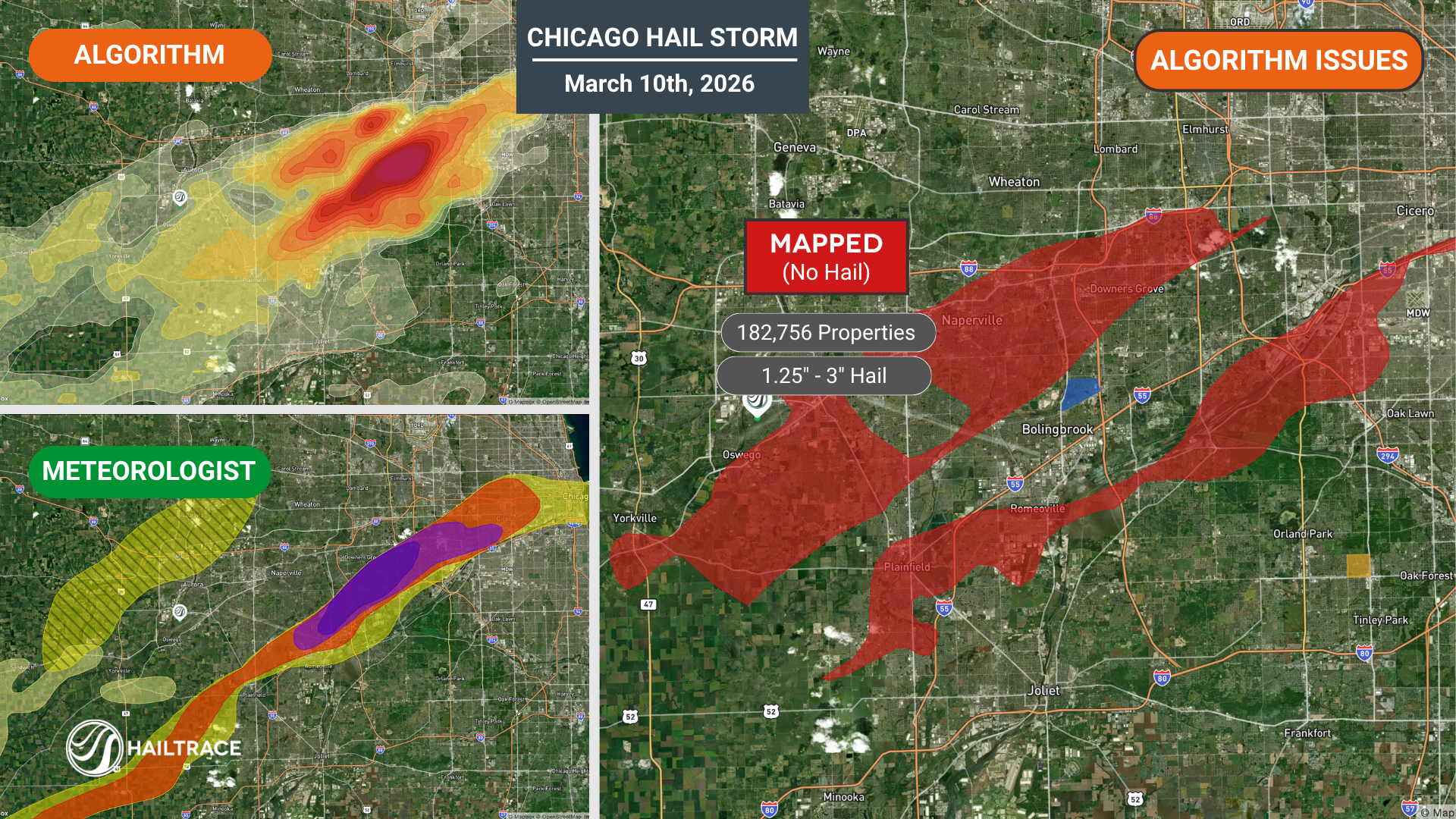
The March 10th, 2026 storm that hit Chicago, Illinois highlights how algorithms can significantly overestimate a storm's footprint, making a storm appear much larger than it actually was.
Algorithm Map Results
- ❌ 182,756 properties mapped as receiving 1.25"–3" hail
- ❌ Large portions of the mapped area received little or no meaningful hail
Business Impact
- Sales teams spread across neighborhoods with little opportunity
- Marketing budgets diluted over an oversized storm area
- More time spent searching instead of selling
March 6, 2026 — Lansing, Michigan
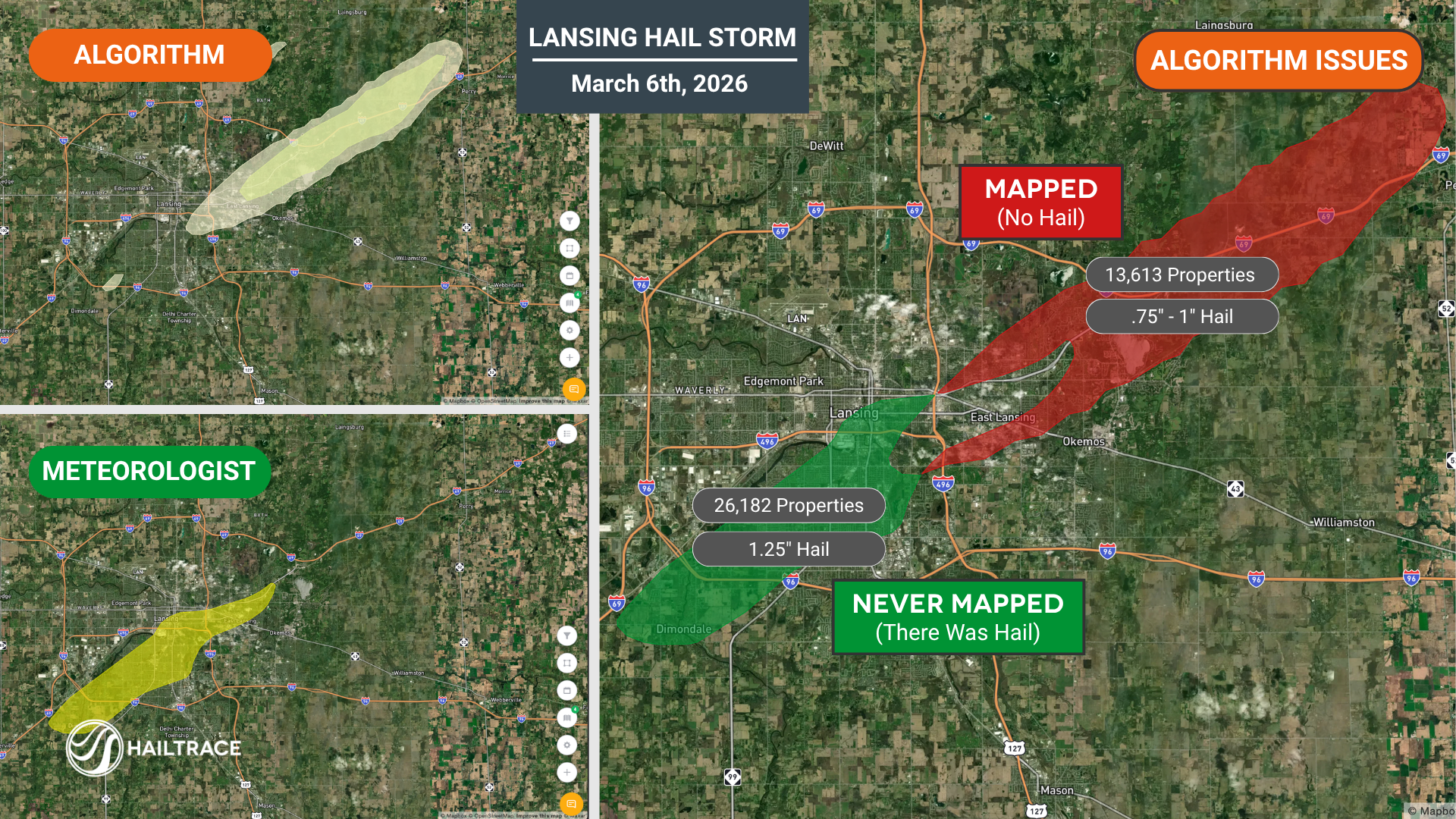
In markets that don't experience frequent hailstorms, accuracy becomes even more important.
The March 6th, 2026 storm that hit Lansing, Michigan demonstrates how one inaccurate map can both create false opportunities and hide real ones.
Algorithm Map Results
- ❌ 13,613 properties incorrectly mapped as receiving 0.75"–1" hail
- ❌ 26,182 properties receiving approximately 1.25" hail were completely missed
Business Impact
- Contractors could have worked neighborhoods without meaningful damage
- One of the area's best roofing opportunities never appeared on the map
- In lower-frequency storm markets, missing a storm like this can mean missing one of the year's biggest sales opportunities
See the Difference for Yourself
Inaccurate hail maps can cost thousands in wasted marketing and missed opportunities.
See how HailTrace's meteorologist-created maps can help protect your bottom line.
Why HailTrace Approaches Storm Mapping Differently
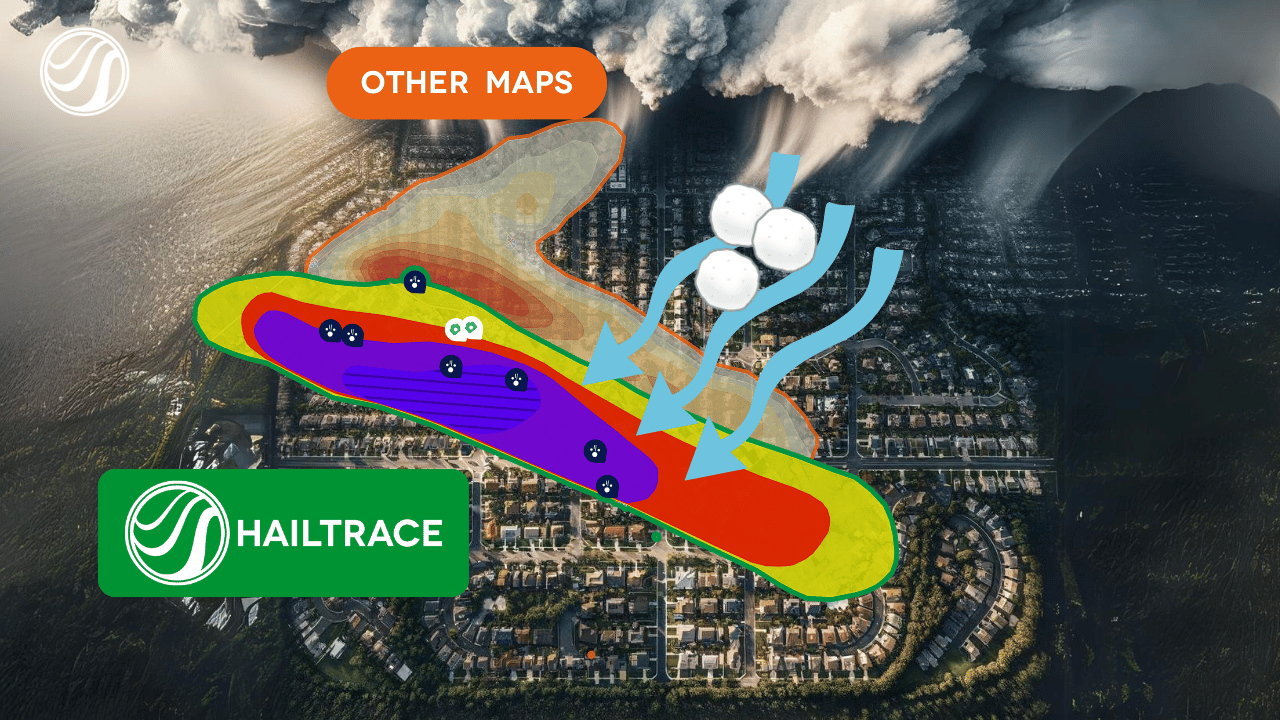
Not all hail maps are created the same.
Some rely primarily on automated algorithms.
HailTrace is one of the only weather providers with an in-house team of meteorologists creating hail maps.
Our meteorologists combine their expertise, radar, and real-world storm evidence to create maps that better reflect what actually happened on the ground.
Why does that matter?
Because every decision after a storm starts with the map.
Trust the right map, and every decision that follows becomes easier.
Work the Right Neighborhoods with HailTrace
Every decision after a storm starts with the map you trust.
See how HailTrace's meteorologist-created hail maps can help you avoid wasted time, reduce marketing costs, and find more roofing opportunities.